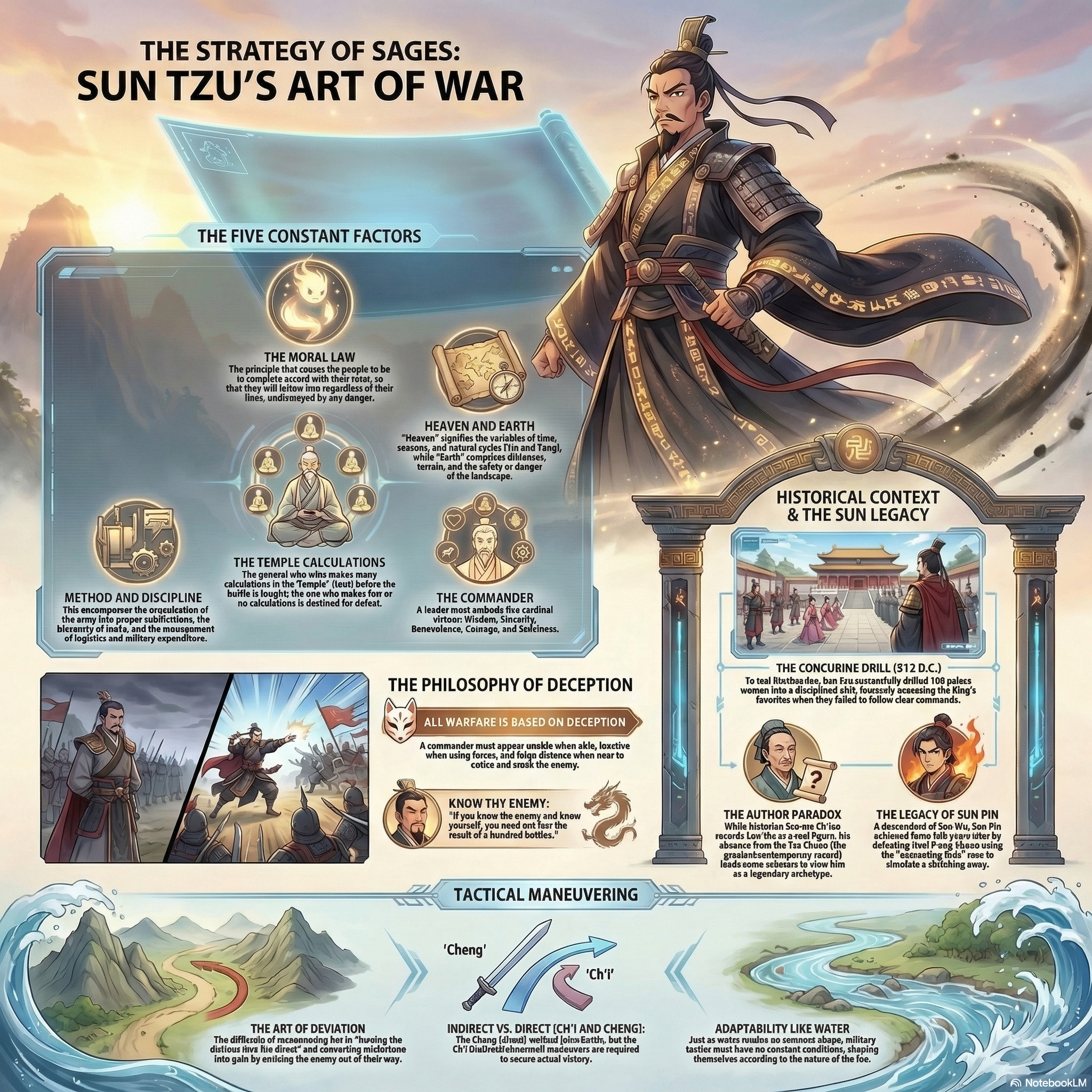
The Art of War is roughly 2,500 years old, and it is still the most practical book on strategy ever written. If you train in martial arts and you have not read it, you are missing something that will change the way you spar, compete, and think about combat.
Sun Tzu was a Chinese military general and strategist, and his text was written for commanders leading armies across terrain. But the principles he laid out are universal. They apply to any situation where two opponents face each other with something at stake. That includes the sparring ring, the competition floor, and the grading panel.
Thirteen Chapters, Thirteen Forms
The Art of War is structured in thirteen chapters, each addressing a different dimension of conflict. For Zen Do Kai practitioners, there is a resonance worth noting: our system preserves thirteen core forms. The parallel is not accidental in spirit, even if it is coincidental in number. Both structures reflect a conviction that combat mastery is not one skill but many, layered and interconnected.
Sun Tzu begins with assessment and planning, moves through the economics of sustained conflict, and progresses into terrain, timing, intelligence, and the use of fire and agents. Each chapter builds on what came before. The text is not a list of tricks. It is a system of thinking.
Know Yourself, Know Your Opponent
The most quoted line from the Art of War is the most important one: "If you know the enemy and know yourself, you need not fear the result of a hundred battles." Every martial artist who has ever stepped into a ring understands this intuitively. The fighter who knows their own weaknesses and reads their opponent's habits will win against a stronger, faster opponent who operates on instinct alone.
This is not abstract philosophy. It is Tuesday night sparring. The partner who always drops their guard after a combination. The one who telegraphs a right cross with a shoulder shift. The one who panics when pressed into the corner. Sun Tzu is telling you to study these things deliberately, to catalogue them, and to build your strategy around what you know rather than what you hope.
It also means knowing yourself honestly. If your cardio fades after two minutes, you need a strategy that accounts for that. If your left kick is unreliable, you need to stop pretending it will land when it matters. Sun Tzu has no patience for self-deception. Neither does the sparring ring.
Timing and Initiative
Chapter seven of the Art of War deals with manoeuvring, and it contains the idea that has the most direct application to hand-to-hand combat: the concept of timing as a weapon. Sun Tzu writes about arriving at a position before your opponent expects you there, about controlling the tempo of engagement so that the enemy is always responding to you rather than executing their own plan.
In Japanese martial arts terminology, this maps directly to the concept of sen — initiative. Sen no sen is attacking in the moment your opponent initiates. Go no sen is responding after the attack with a decisive counter. Sen sen no sen is acting before the intention even fully forms. Sun Tzu understood all three, centuries before anyone gave them Japanese names.
When you watch a skilled fighter control the pace of a bout — pushing forward to create pressure, pulling back to draw the opponent out, then striking in the gap — you are watching the Art of War in action. The fighter who dictates tempo wins. Sun Tzu knew this when your dojo's building was a forest.
Deception and Adaptability
"All warfare is based on deception." This is the line that makes people uncomfortable, because martial arts culture likes to talk about honour and directness. But Sun Tzu is not talking about dishonesty. He is talking about controlling information. A feint is deception. A switch stance is deception. Keeping your breathing steady when you are exhausted is deception. Every fighter uses it. Sun Tzu simply asks you to do it deliberately.
Adaptability is the deeper lesson. Sun Tzu compares the ideal strategy to water: it flows around obstacles, fills every gap, and takes the shape of whatever contains it. A rigid game plan will break against an opponent who does not behave as expected. The martial artist who can read the situation and adjust in real time — changing range, changing rhythm, changing targets — is practising what Sun Tzu preached.
This is especially relevant in Zen Do Kai, which was designed from the outset as a freestyle system. Our art draws from multiple traditions precisely because no single approach works against every opponent. Sun Tzu would have approved.
Terrain and Positioning
Several chapters of the Art of War deal with terrain — the physical space of combat. Sun Tzu categorises ground into types: dispersive, frontier, key, open, intersecting, serious, difficult, enclosed, and desperate. Each requires a different approach.
In a sparring context, this translates to ring awareness. Where you are relative to the ropes or the edge of the mat matters enormously. Fighting in the centre gives you options. Fighting with your back to the boundary limits them. Being pressed into a corner is Sun Tzu's "desperate ground" — and his advice for desperate ground is the same as any experienced coach's: fight with everything you have, because retreat is not available.
Positioning also means range management. The distance between you and your opponent determines which techniques are available to each of you. A kicker wants long range. A grappler wants close range. Sun Tzu's advice to choose ground that favours your strengths and denies your opponent theirs is range management in ancient Chinese dress.
Intelligence Gathering
The final chapter of the Art of War deals with the use of spies and intelligence. In a competition context, this is scouting. Watching your opponent's earlier bouts. Noticing their preferred combinations, their recovery patterns, their habits under pressure. In a grading context, it is preparation: understanding what the panel expects, what the criteria are, where previous candidates have succeeded or fallen short.
Sun Tzu says that the general who wins is the one with the best information. In martial arts, the fighter who has done their homework — who knows their opponent's tendencies before the first exchange — starts with an advantage that technique alone cannot overcome.
How to Read It
The Art of War is short. Most translations run to about 50 pages of actual text. You can read it in a single sitting, and you should — once, to get the shape of it.
After that first read, go back and work through it in three layers. Start with chapters 1, 3, and 6: "Laying Plans," "Attack by Stratagem," and "Weak Points and Strong." These three chapters contain the foundational principles — assessment, efficiency, and exploiting openings. They are the strategic core.
Then read the tactical chapters: 7 through 11. These deal with manoeuvring, variation, terrain, and the nine situations. This is where Sun Tzu gets specific about movement, timing, and positional play. Read these with sparring in mind and you will see your own training reflected back at you.
Finally, read the meta-chapters: 12 and 13, on fire and intelligence. These are about force multipliers and information — the things that amplify everything else you do.
Keep a copy in your training bag. Read a chapter before class. Over time, the ideas will start appearing in your sparring without conscious effort. That is the point. Sun Tzu wrote a book about winning, and the best way to use it is to absorb it until thinking strategically becomes as automatic as keeping your guard up.