Miyamoto Musashi killed his first opponent in single combat at the age of thirteen. Over the next three decades, he fought approximately sixty duels and never lost. When he finally sat down to write about what he had learned, the result was the Book of Five Rings — the most direct, experience-based text on combat strategy ever committed to paper.
This is not a book written by a philosopher who theorised about fighting. It was written by a man who did it, repeatedly, with lethal consequences for the other party. That directness is what makes it invaluable for martial artists. Musashi does not waste words. Every sentence comes from something he tested with a sword in his hand.
The Senjo Connection
If you train in Zen Do Kai, you have already encountered Musashi's work — even if you did not know it. The Senjo ceremony, which accompanies senior gradings and significant training events, references both Sun Tzu and Musashi as warrior-scholars whose writings inform the martial path. The Book of Five Rings sits alongside the Art of War as one of the two foundational strategic texts in our tradition. Where Sun Tzu gives you the general's view from the hilltop, Musashi gives you the fighter's view from the floor.
Five Books, Five Elements
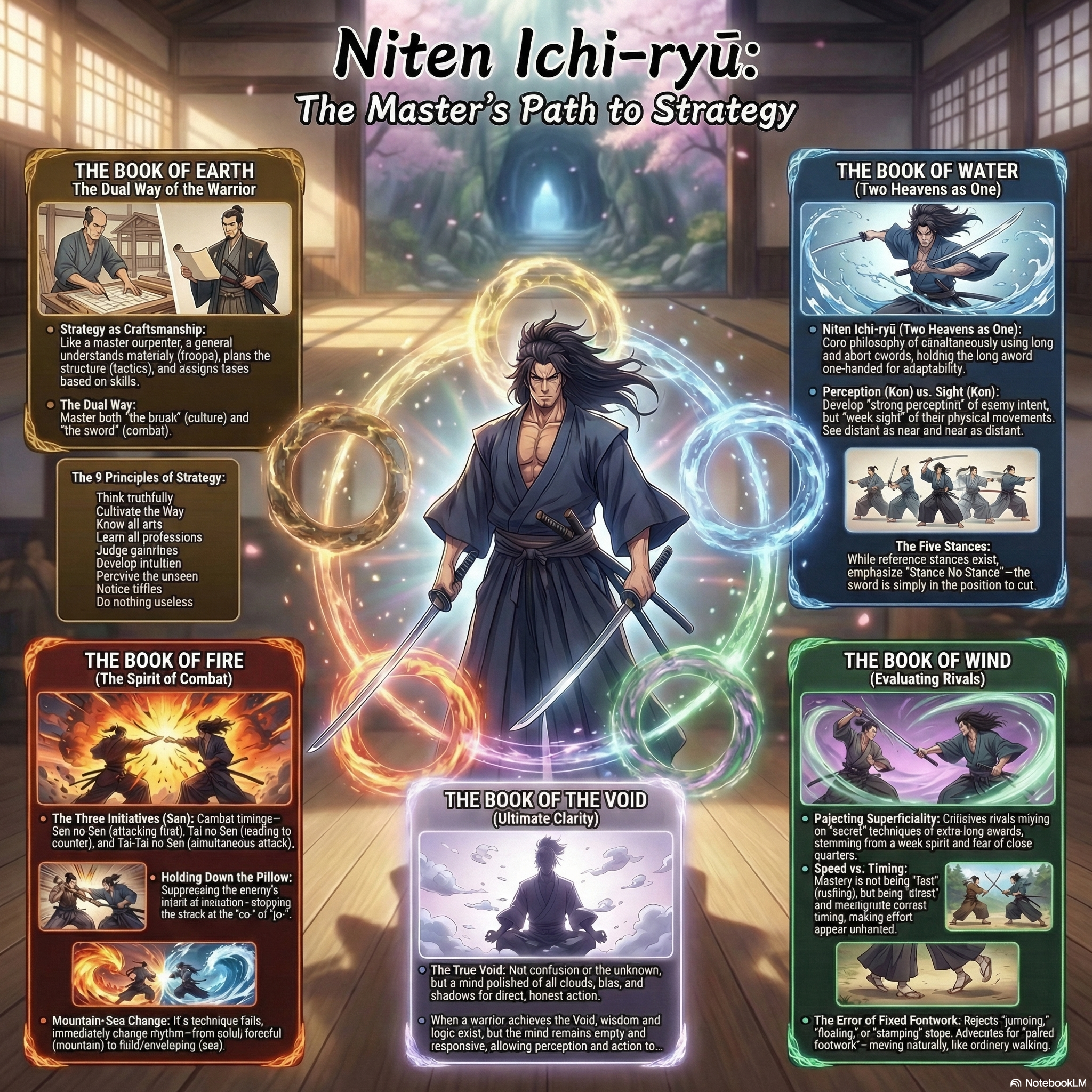
Musashi structured his text around the classical Japanese five elements: Earth, Water, Fire, Wind, and Void. Each element corresponds to a dimension of martial understanding, and together they form a complete framework for thinking about combat.
The Earth book is the foundation. Musashi lays out his background, his approach, and the basic principles of his two-sword style. For us, this is the equivalent of white-belt fundamentals: stance, guard, distance, and the attitude you bring to training. Musashi insists that the martial path must be grounded in daily practice and broad study — not just technique, but an understanding of rhythm, timing, and the trades and crafts of life. A martial artist who only knows fighting, he argues, does not truly understand fighting.
The Water book addresses adaptability. Musashi writes about taking the shape of your situation, flowing around obstacles, and maintaining a calm, clear state of mind regardless of what your opponent does. Water fills any container. The martial artist who can adjust their range, rhythm, and technique selection to match whatever they face is practising what Musashi describes here. When your game plan falls apart thirty seconds into a bout, your ability to become water is what saves you.
The Fire book is about initiative and aggression. This is Musashi at his most tactical — discussing how to seize the initiative, how to attack in rhythm and out of rhythm, how to read your opponent's intention and strike before they can execute. Fire is the chapter that most directly applies to sparring and competition. Musashi talks about "crossing at a ford" — committing fully to an attack at the moment of opportunity — and about creating openings through pressure and disruption. If you have ever watched a fighter take control of a bout in the first exchange and never give it back, you have seen Fire in action.
The Wind book examines other styles and schools. Musashi critiques approaches that rely on a single weapon, a single range, or a fixed set of techniques. His argument is simple: if you only know your own system, you are vulnerable to anything outside it. This chapter is practically the founding document of cross-training philosophy. Zen Do Kai was built on the same principle — draw from everything, be limited by nothing. When Musashi dissects the weaknesses of schools that favour long swords, or short swords, or speed over power, he is making the same argument that led Bob Jones and Richard Norton to create a freestyle system four centuries later.
The Void book is the shortest and the most difficult. It addresses the state beyond technique — where training has been so deeply internalised that the practitioner acts without conscious thought. In modern terms, this is flow state. In traditional terms, it is mushin — no-mind. Musashi describes this not as mysticism but as the natural result of sufficient practice. You do not achieve the Void by meditating on it. You achieve it by training until technique disappears into reflex.
The Directness of Experience
What separates Musashi from almost every other martial arts writer is his bluntness. He has no interest in impressing you. He does not dress his ideas in poetic language or spiritual metaphor. When he tells you to study timing, he means it literally: go and observe how timing works in different contexts, then apply what you learn.
He writes about combat the way an experienced tradesman writes about their craft — with complete confidence, no wasted motion, and an impatience for anything decorative. There is a passage in the Fire book where he discusses the importance of not having a "favourite technique." His argument is that the fighter who relies on a preferred combination becomes predictable. The opponent learns to expect it, and the favourite technique becomes a liability.
Every martial artist who has been caught with their signature move countered and shut down knows exactly what Musashi means. His solution is characteristic: do not have favourites. Be equally capable at every range and with every tool. This is not a comfortable instruction, but it is a correct one.
Rhythm and Timing
Musashi returns to rhythm obsessively. He identifies different types of rhythm — the rhythm of attack, the rhythm of defence, the rhythm of the interval between exchanges — and argues that the fighter who controls rhythm controls the fight. This is the same insight that makes experienced fighters so difficult to spar with. They do not simply hit harder or move faster. They control the tempo, and you find yourself always half a beat behind.
He also describes broken rhythm: deliberately disrupting the expected pattern to create openings. Attack-attack-pause-attack. Fast-fast-slow-fast. The opponent's brain predicts a pattern, and when the pattern breaks, there is a moment of confusion. Musashi says to strike in that moment. Modern sports science calls this "pattern disruption." Musashi called it winning.
How to Read It
Start with the Earth book. It provides context for everything that follows, and Musashi's description of his own path gives you a framework for understanding his authority. Do not skip this section — it grounds the entire text.
Next, read the Water book. This is where Musashi's philosophy of adaptability and mental clarity is most fully developed. Read it slowly. The concepts are simple to state but deep in application. If you train with these ideas in mind for a few weeks, you will notice changes in how you respond to unexpected situations in sparring.
Then read the Fire book. This is the tactical core — the chapter you will return to most often before competitions or hard sparring sessions. Musashi's descriptions of initiative, pressure, and exploiting hesitation are immediately applicable.
Wind and Void are best read last, and they reward re-reading over time. Wind will sharpen your understanding of what makes different martial arts approaches effective or limited. Void will make more sense the longer you train — it describes something that cannot be taught, only discovered through sustained practice.
Keep this book close. Musashi earned every word in it the hard way.