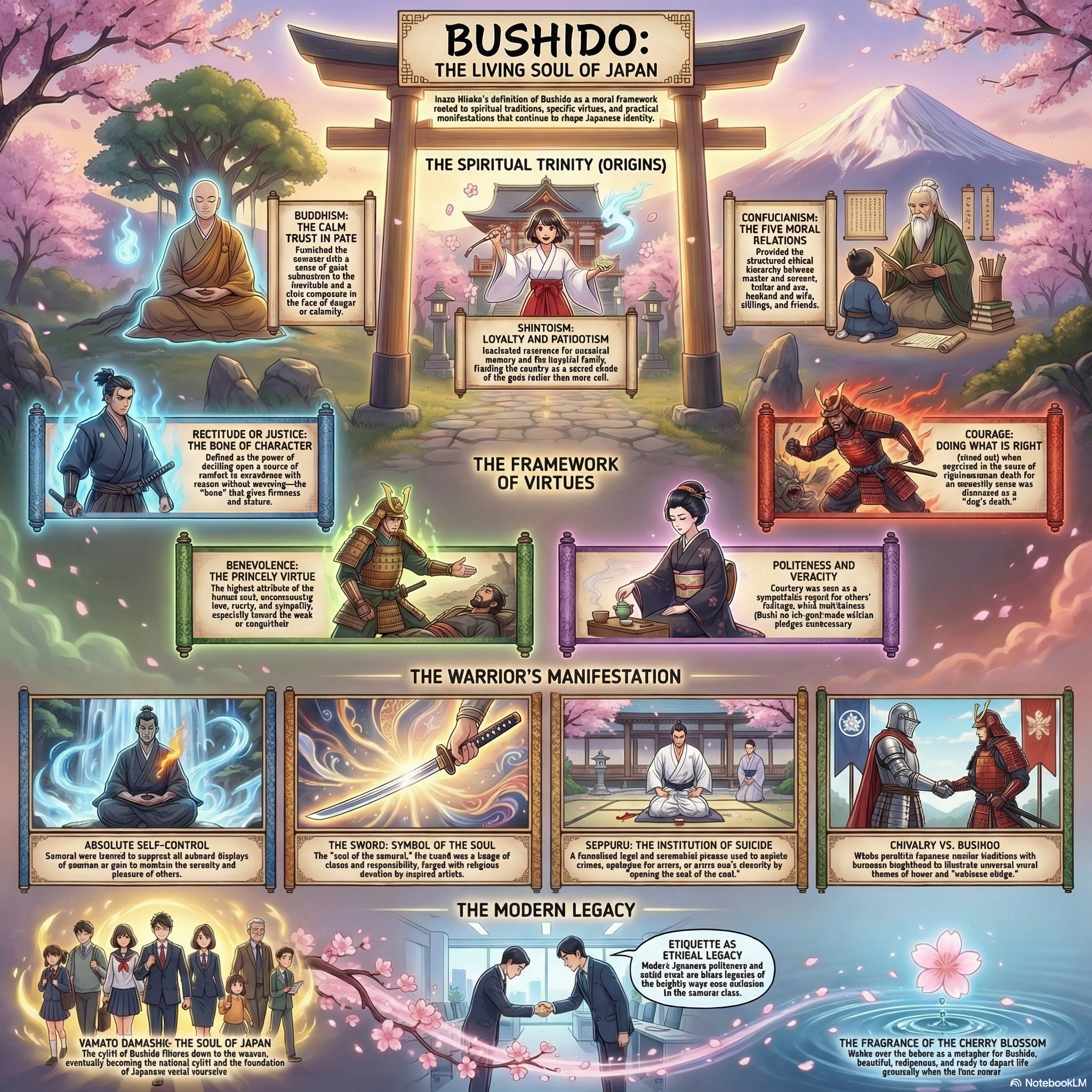
In 1899, a Japanese agricultural scientist named Inazo Nitobe sat down to answer a question his wife had asked him: why do the Japanese believe what they believe about right and wrong, if they have no formal religious education? His answer became Bushido: The Soul of Japan — the book that introduced the samurai ethical code to the Western world and, in the process, shaped how martial artists everywhere think about what the belt means beyond technique.
Nitobe did not invent Bushido. The ethical framework he describes had been developing for centuries within Japanese warrior culture, informed by Confucianism, Buddhism, Shinto, and the practical demands of a military aristocracy. What Nitobe did was systematise it — distilling the code into seven core virtues and explaining each one in terms that a Western audience could understand. His book was originally written in English, published in Philadelphia, and became an international bestseller.
The Seven Virtues
Justice (Gi) is the first and most important virtue. For Nitobe, justice is the bone that gives the body its structure. A samurai without justice is simply a skilled killer. Justice means doing what is right because it is right — not because it is convenient, rewarded, or observed. In the dojo, this is the principle that separates a martial artist from a fighter. You do not hit after the bell. You do not target an injury. You do not use your skills on someone who cannot defend themselves. These are not rules imposed from outside. They are expressions of justice internalised.
Courage (Yu) is doing what is right even when it is dangerous or difficult. Nitobe distinguishes between courage and mere recklessness. True courage is calm, considered, and in service of justice. The martial artist who steps into the ring despite fear is courageous. The one who picks fights to prove something is reckless. The distinction matters.
Benevolence (Jin) is the virtue that tempers strength with compassion. The samurai who has the power to destroy must also have the restraint to show mercy. In training, benevolence is what makes a senior student safe to spar with — the knowledge that they will control their power, help you up when you fall, and invest in your development rather than their ego.
Politeness (Rei) is not mere manners. For Nitobe, politeness is the outward expression of respect for others. The bow at the beginning and end of class, the formal address of instructors, the etiquette of the dojo — these are not empty rituals. They are the daily practice of recognising the dignity of everyone on the floor, regardless of rank.
Sincerity (Makoto) is truthfulness in word and action. The samurai's word was their bond, to the point where written contracts were considered insulting — a suggestion that the person's word alone was not sufficient. In martial arts, sincerity means training honestly. Not pretending a technique worked when it did not. Not inflating your hours. Not performing for the instructor while cutting corners when their back is turned.
Honour (Meiyo) is the keen awareness of personal dignity and moral worth. A samurai guarded their honour above their life — not out of pride, but because honour reflected the accumulated weight of their conduct. For martial artists, honour is reputation earned through consistent behaviour over time. It is what people say about your character when you are not in the room.
Loyalty (Chugi) is faithfulness to those you serve and those who depend on you. In feudal Japan, this meant absolute devotion to one's lord. In the modern dojo, loyalty is showing up — to training, to your training partners, to your instructor, and to your club. It is the virtue that sustains a martial arts journey through the years when progress feels invisible and motivation fades.
From Samurai Code to Belt Grading
When you stand before a grading panel, you are being assessed on more than technique. Every grading system in traditional martial arts carries an implicit character assessment. Can this person be trusted with the skills and authority that come with the next belt? Are they disciplined enough, composed enough, and ethical enough to represent the art well?
These questions are Bushido in modern dress. The grading panel is not just checking whether you can perform the required kata or land the required combinations. They are looking for the seven virtues in action: the justice of clean technique, the courage to perform under pressure, the benevolence of controlled sparring, the politeness of proper etiquette, the sincerity of genuine effort, the honour of accepting the result, and the loyalty of having shown up consistently enough to earn the opportunity.
Understanding Bushido transforms a grading from a technical examination into something deeper. You are not just demonstrating what your body can do. You are demonstrating who you are.
The Bridge Between Hagakure and the Modern Dojo
If the Hagakure is the raw, unfiltered voice of warrior ethics — blunt, intense, and rooted in the specific realities of feudal Japan — then Bushido is its translation into universal principles. Nitobe took the same cultural material that Tsunetomo lived and breathed and rendered it accessible to anyone, anywhere.
This is why both texts appear on the Wolf Clan reading list. The Hagakure gives you the feeling of the warrior's path — its urgency, its demands, its refusal to compromise. Bushido gives you the framework — the seven named virtues that you can examine, develop, and measure yourself against. Together, they provide both the fire and the structure.
Nitobe was writing at a time when Japan was rapidly modernising, and part of his project was to demonstrate that Japanese ethical culture could stand alongside Western moral philosophy. He draws explicit parallels between Bushido and European chivalry, between the samurai code and Christian ethics. Whether those parallels are precise is debatable. What is not debatable is that the virtues he describes — justice, courage, compassion, respect, honesty, honour, loyalty — are recognised as virtues in every martial arts tradition on earth.
Living the Code
The most important thing about Bushido is that it is meant to be practised, not just understood. Nitobe is clear on this point: the samurai code was not a set of beliefs to be held. It was a set of behaviours to be performed, daily, without exception. You do not become just by believing in justice. You become just by acting justly, repeatedly, until justice becomes your default mode.
This is identical to how martial arts technique works. You do not learn a front kick by understanding the biomechanics. You learn it by throwing ten thousand front kicks until the movement is part of your body. Bushido applies the same logic to character. The virtues are skills. They are developed through repetition, refined through correction, and tested under pressure — just like everything else you learn on the training floor.
How to Read It
Bushido is best read sequentially. Nitobe structured the virtues in a deliberate order — each one builds on those before it. Justice provides the foundation; courage allows you to act on justice; benevolence tempers courage with compassion; and so on through the remaining virtues. Skipping ahead breaks the logic of his argument.
The book is short — around 130 pages in most editions — and written in clear, accessible prose. Nitobe was writing for a general Western audience, and the text requires no special background in Japanese history or philosophy to understand.
After your first read, keep the seven virtues in mind during training for a week. Notice which ones come naturally to you and which ones require effort. That gap between your natural tendencies and the full set of seven is your character development curriculum — and it is at least as important as your technical syllabus.