Epictetus was born a slave in the Roman Empire around 50 AD. He was owned, beaten, and — according to one account — had his leg deliberately broken by his master. When he was eventually freed, he became a philosophy teacher. He never wrote anything down. His student Arrian transcribed his teachings and distilled them into a short handbook called the Enchiridion — Greek for "the thing you keep in your hand." It was designed to be carried, consulted, and used under pressure.
The Enchiridion is roughly fifty chapters long. You can read it in an hour. It contains the single most useful mental framework ever articulated for anyone who must perform under conditions they cannot fully control. That includes every martial artist who has ever stepped onto a competition floor, stood before a grading panel, or walked into a sparring session against someone bigger, faster, or more experienced.
The Dichotomy of Control
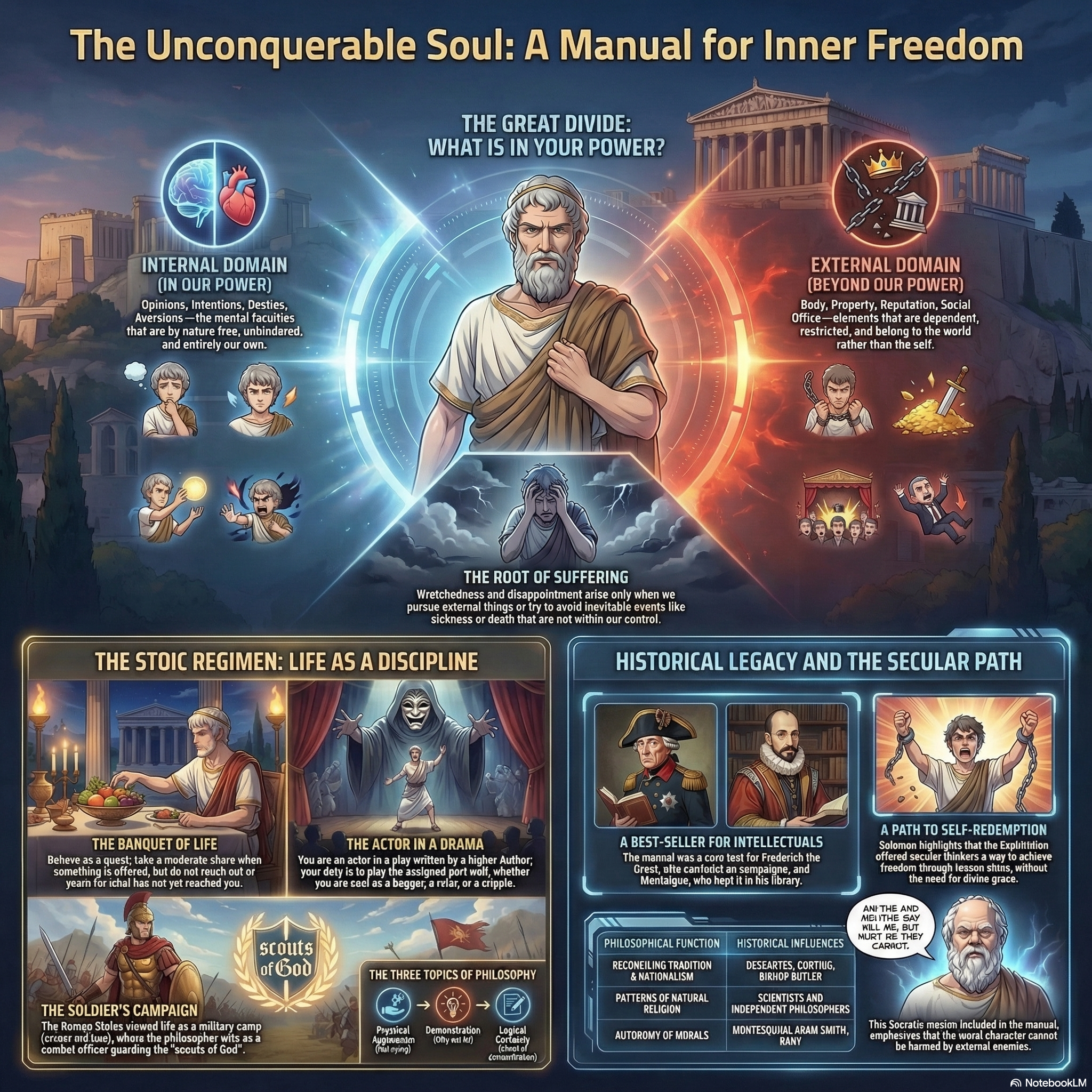
Chapter 1 of the Enchiridion contains the idea that everything else in the book depends on: "Some things are within our power, while others are not. Within our power are opinion, motivation, desire, aversion, and, in a word, whatever is of our own doing. Not within our power are our body, our property, reputation, office, and, in a word, whatever is not of our own doing."
Read that again, because it is the most important paragraph you will encounter on the Warriors Library reading list. Epictetus is drawing a line between the things you can control and the things you cannot, and he is telling you to invest your entire mental energy on the first category and release the second completely.
For a martial artist, this resolves almost every source of anxiety. You cannot control your opponent's skill level — but you can control your preparation. You cannot control the judges' scoring — but you can control the quality of your technique. You cannot control whether the grading panel passes you — but you can control whether you give everything you have on the floor. You cannot control whether your body cooperates perfectly on the day — but you can control your response when it does not.
The fighter who has internalised this distinction walks into the ring calmer, clearer, and more focused than the one who is trying to control everything. Epictetus would tell you that most pre-competition anxiety is the result of trying to control things that are not yours to control. Stop doing that, and the anxiety largely resolves itself.
When Your Opponent Scores
Chapter 5 of the Enchiridion addresses what happens when things go wrong: "It is not things that disturb us, but our judgements about things." Your opponent lands a clean head kick. The scoreboard updates against you. The grading panel asks you to repeat a section. In each case, the event itself is neutral. It is your interpretation of the event — the story you tell yourself about what it means — that produces the emotional response.
If your opponent scores and you think "I am losing, this is a disaster, I cannot recover," your body will respond to that story with tension, panic, and deteriorating technique. If the same score lands and you think "they found an opening, I need to adjust my guard, the bout is still going," your body stays in working mode. The external event is identical. The internal response — and therefore the practical outcome — is entirely different.
This is not positive thinking or denial. Epictetus is not asking you to pretend the score did not happen. He is asking you to separate the fact from the judgement. The fact: your opponent scored. The judgement: everything is ruined. The fact is real and requires a response. The judgement is optional and produces nothing useful. Drop the judgement, keep the fact, and respond accordingly.
The Grading Panel Says "Not Yet"
One of the hardest moments in a martial artist's journey is failing a grading. You prepared for months. You trained as hard as you could. And the panel decided you were not ready. Epictetus addresses this situation directly, though he uses different examples: "Remember that you are an actor in a drama of such a kind as the author pleases to make it. If short, of a short one; if long, of a long one. If it is his pleasure you should act a poor man, a cripple, a governor, or a private person, see that you act it naturally. For this is your business — to act well the character assigned you. To choose it is another's."
The grading result is not within your power. Your performance is. If you performed to the best of your ability, you have done your part. The panel's decision belongs to them. This does not mean the decision is wrong — it may well be right, and you may genuinely need more time. But your emotional response to the decision is yours to manage. Devastation is a choice. Disappointment is natural. Using the feedback to improve and returning better prepared — that is the Stoic response.
When Your Body Will Not Cooperate
Epictetus lived with a permanent disability — his damaged leg never healed properly. He knew what it was like to have a body that would not do what the mind wanted. His response was characteristically direct: the body is not within your power. Your response to its limitations is.
Every martial artist encounters this. The knee that aches. The shoulder that restricts your range. The cardio that fades earlier than it should. The technique that your body cannot seem to learn no matter how many repetitions you put in. Epictetus does not offer false comfort. He does not promise that positive thinking will heal your knee. He offers something more useful: the distinction between the limitation (which you may not be able to change) and your attitude toward it (which you always can).
The martial artist who accepts a physical limitation and adapts their training around it makes progress. The one who rages against it, denies it, or uses it as an excuse for quitting makes none. Epictetus would recognise the first response as wisdom and the second as a failure to understand what is and is not within your power.
Daily Practice
The Enchiridion is not a book of ideas to be understood once and filed away. It is a book of practices to be applied daily. Epictetus structured his teaching as a series of exercises — mental habits to be developed through repetition, just like physical techniques. Each morning, review what is within your power and what is not. Before each challenging situation, remind yourself of the distinction. After each event that disturbs you, examine whether your disturbance came from the event itself or from your judgement about it.
This is mental training in the most literal sense. Epictetus treats the mind the same way a martial arts instructor treats the body: as something that must be conditioned through deliberate, repeated practice. You do not develop composure by thinking about composure. You develop it by practising the Stoic exercises until they become automatic — until the first response to any setback is to ask "is this within my power?" rather than to spiral into frustration or despair.
The Companion to Marcus Aurelius
If you have already read the Meditations, the Enchiridion will feel familiar. Marcus Aurelius was deeply influenced by Epictetus — he references the Stoic teacher explicitly, and many of his journal entries are essentially applications of Epictetus's principles to the specific challenges of ruling an empire. The two texts complement each other perfectly. Marcus Aurelius shows you what it looks like to apply Stoic philosophy under extreme pressure over decades. Epictetus gives you the core principles in their clearest, most distilled form.
Together, they provide a complete mental training system for anyone who must perform under pressure. The Enchiridion gives you the framework. The Meditations shows you what a lifetime of applying that framework looks like.
How to Read It
Read the Enchiridion straight through. It is short enough to finish in a single sitting, and the argument builds progressively from Chapter 1's dichotomy of control through increasingly specific applications. On your first read, just absorb the shape of the thing.
Then go back and re-read chapters 1, 5, and 8 carefully. Chapter 1 is the foundation — the dichotomy of control. Chapter 5 is the principle that events do not disturb you; your judgements about events disturb you. Chapter 8 addresses desire and aversion — wanting things to be other than they are. These three chapters contain the core toolkit.
Before your next grading or competition, read those three chapters again. They take about five minutes. Then put the book down and go train. The ideas will be sitting in the back of your mind when you need them — when the score goes against you, when the panel asks something unexpected, when your body does not cooperate, when the pressure builds and the untrained mind would panic.
Epictetus was a former slave who could not control almost anything about his external circumstances. He responded by developing the most rigorous system ever created for controlling the one thing that was within his power: his own mind. That system is in this book, and it is yours to use.