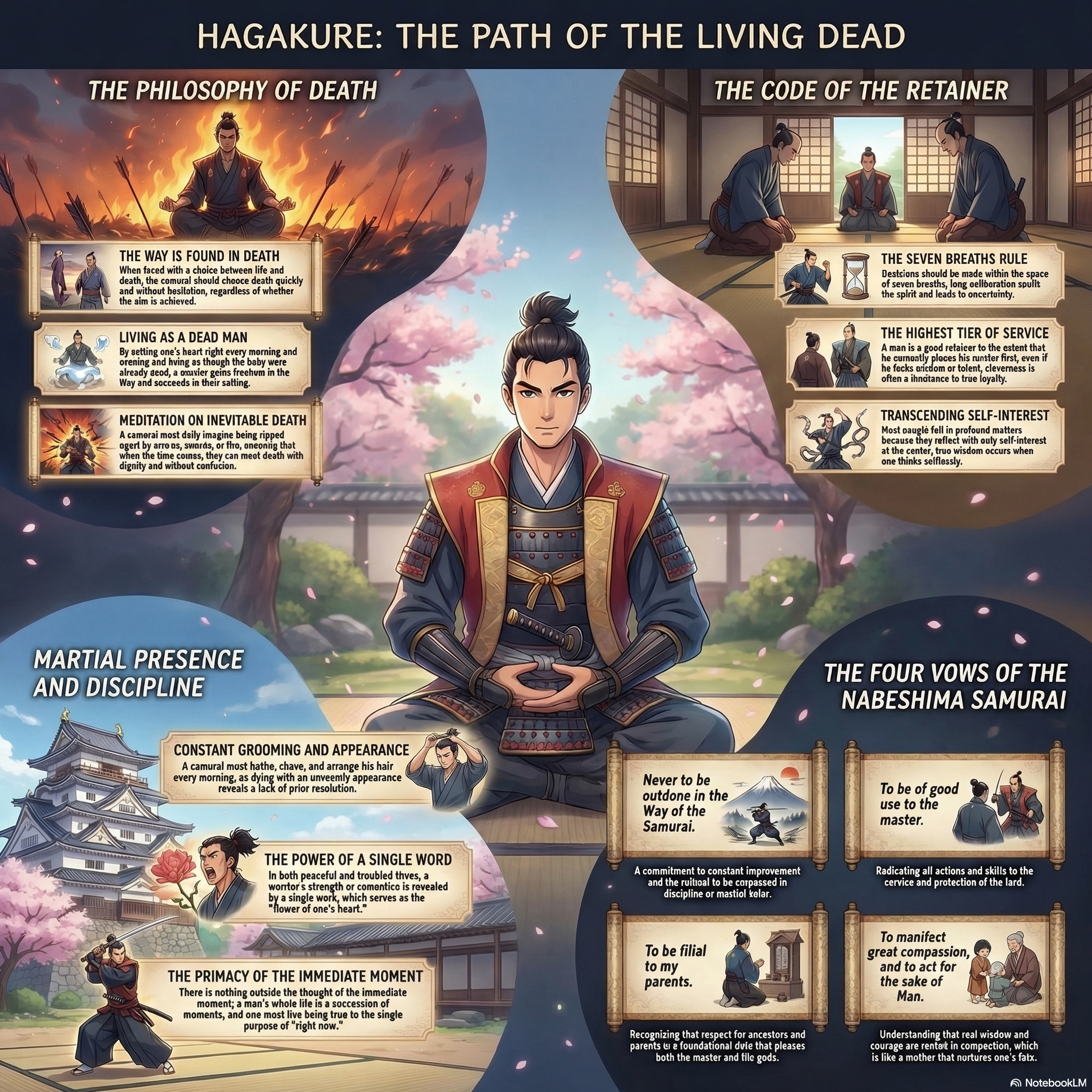
"The Way of the warrior is death." That is the most famous line in the Hagakure, and it is the reason most people put the book down before they understand it. Read out of context, it sounds like morbid fatalism — a death cult dressed in samurai robes. Read properly, it is one of the most liberating ideas in martial philosophy.
Yamamoto Tsunetomo was a samurai retainer in the Nabeshima clan during the early eighteenth century. When his lord died, Tsunetomo wanted to follow the tradition of junshi — ritual suicide in the service of one's master — but the practice had been banned. Instead, he became a Buddhist monk and spent his remaining years dictating his thoughts on the warrior's path to a younger samurai named Tashiro Tsuramoto. Those dictations became the Hagakure — "Hidden Leaves" — a text that was kept within the Nabeshima domain and not published for the wider world until the twentieth century.
Death as Liberation
Tsunetomo's central teaching is not that a warrior should seek death. It is that a warrior should accept death so completely that the fear of it no longer controls their actions. This is a practical instruction, not a spiritual one. The samurai who has already accepted that they might die today is free to act with total commitment. The one who is trying to survive is hesitant, cautious, and half a step behind.
Every martial artist has experienced a version of this. The moment you step into the ring worried about getting hit, you get hit more. The moment you stop caring about the hit and commit fully to your attack, everything flows. Fear of failure produces the very failure you are afraid of. Tsunetomo understood this three hundred years before sports psychologists gave it a name.
His "morning death meditation" is the practical application. Each morning, the warrior should vividly imagine their own death — by sword, by arrow, by fire, by every means possible. Having died in the mind, the warrior walks into the day without hesitation. It sounds extreme. It is also remarkably similar to the visualisation techniques used by modern combat athletes and special forces operators to manage fear and perform under pressure.
Daily Conduct and the Warrior’s Bearing
Much of the Hagakure has nothing to do with combat. Tsunetomo spends considerable time on grooming, manners, speech, and daily habits. A samurai should be clean and well-presented at all times — not out of vanity, but because a warrior might die at any moment and should not be found looking dishevelled. A samurai should speak deliberately, make decisions quickly, and avoid unnecessary complaints.
This emphasis on bearing and conduct is directly relevant to the dojo. How you present yourself on the training floor — your uniform, your posture, the way you bow, the way you address senior students — is not ceremony for its own sake. It is the external expression of an internal discipline. Tsunetomo would tell you that a martial artist who is sloppy in their bearing will be sloppy in their technique, and he would be right.
He also has characteristically blunt advice on decision-making: when faced with a choice, make it quickly and commit fully. Hesitation, he argues, is worse than making the wrong choice. A wrong decision made with total commitment can be corrected. A right decision made too late is worthless. In sparring, this translates to something every coach has shouted at some point: "Commit to the technique!" A half-thrown kick is worse than the wrong kick thrown fully. Tsunetomo said the same thing about swords.
Courage and Composure
Tsunetomo draws a distinction between reckless bravery and true courage. Reckless bravery is loud, showy, and often short-lived. True courage, he says, comes from calm resolve — a quiet certainty that does not need to announce itself. The warrior who boasts of their fearlessness is often the first to break. The one who says nothing and keeps walking forward is the one you need to worry about.
This maps perfectly onto what we see in the dojo. The loudest student is rarely the most dangerous. The one who trains quietly, absorbs corrections without ego, and stays composed when the pressure increases — that is the student Tsunetomo would have recognised as having the warrior's spirit. Composure under pressure is a trainable skill, and the Hagakure treats it as such. You build it through daily practice, through accepting discomfort without complaint, and through confronting fear directly rather than avoiding it.
There is a passage where Tsunetomo describes a samurai who was criticised by his lord in front of others. Rather than reacting with anger or shame, the samurai listened, bowed, and went away to correct the fault. Tsunetomo praises this as the highest form of courage — the ability to receive criticism without losing composure. Every martial artist who has been corrected on the floor in front of their peers knows exactly how difficult this is. Every martial artist who has handled it well knows how powerful it is.
Bushido and the Belt
The Hagakure is one of the foundational texts of Bushido — the ethical code of the samurai. While Nitobe's Bushido: The Soul of Japan would later systematise the code for a Western audience, the Hagakure presents it raw and unfiltered. Loyalty, honour, duty, self-discipline — these are not abstract virtues for Tsunetomo. They are daily practices with concrete applications.
When you tie your belt before class, you are participating in a tradition that runs back through Japanese martial culture to the values Tsunetomo described. The belt is not just a marker of technical skill. It is a statement of character — an assertion that the person wearing it has demonstrated the discipline, resilience, and commitment that Bushido demands. Understanding the Hagakure gives that belt more weight. It connects the physical act of training to a philosophical tradition that has sustained warriors for centuries.
The Difficult Parts
It would be dishonest not to mention that parts of the Hagakure are uncomfortable for modern readers. Tsunetomo lived in a feudal society with values that do not translate directly to the twenty-first century. Some of his advice on loyalty and obedience reflects a hierarchical structure that we would not want to replicate. His views on women, on suicide, and on certain forms of devotion belong firmly to their historical context.
Reading the Hagakure well means extracting the principles that are timeless — commitment, composure, daily discipline, acceptance of mortality — while recognising that the specific cultural expressions of those principles are products of their era. This is the same skill you apply when training a traditional kata: you learn the form as it was passed down, understand what it teaches, and apply it to the world you actually live in.
How to Read It
The Hagakure is not structured like a conventional book. It is a collection of observations, anecdotes, and instructions, loosely grouped but not systematically ordered. This can make it disorienting on first encounter. The best approach is to read it in sections rather than cover to cover.
Start with "The Way of the Warrior" — the opening passages that contain Tsunetomo's core philosophy on death, commitment, and the martial path. This is the essential material, and everything else in the text is built on it.
Next, read the sections on daily conduct. Tsunetomo's advice on bearing, decision-making, speech, and personal discipline is immediately practical. You can start applying it in the dojo and in daily life right away.
Then move to the passages on courage and composure. These sections contain the most directly applicable material for competition and grading preparation — the mental training that complements your physical preparation.
Return to the text periodically. The Hagakure is one of those books that says different things depending on where you are in your training. A white belt will read it differently from a brown belt. A black belt will read it differently again. The text does not change. You do.