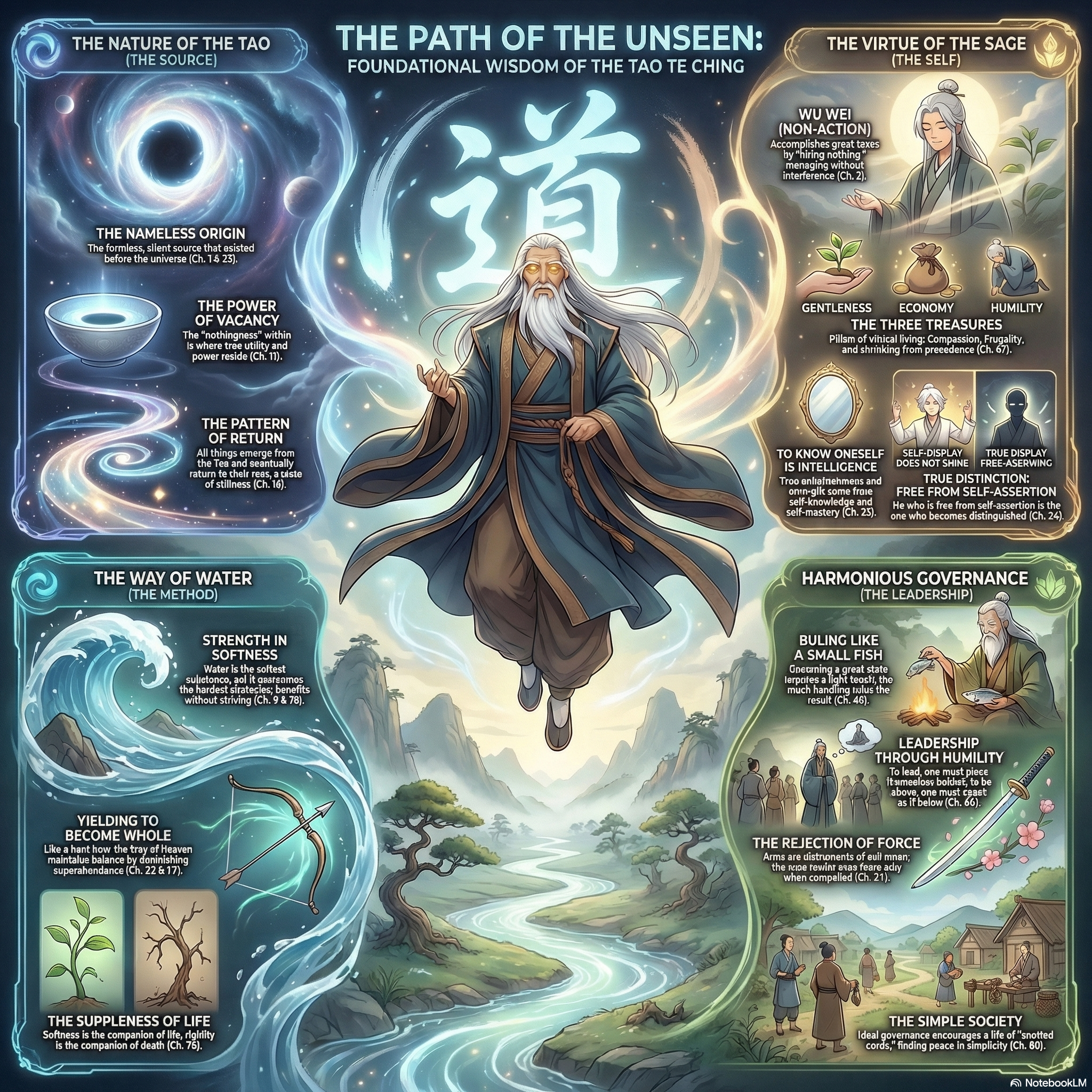
Nothing in the world is softer than water. Yet nothing is better at overcoming the hard. Lao Tzu wrote those words approximately 2,500 years ago, and they remain the most precise description of what good martial arts technique feels like from the receiving end.
The Tao Te Ching is the foundational text of Taoism — 81 short chapters of paradox, poetry, and startlingly practical philosophy. It was not written as a martial arts manual. But the principles it describes — yielding to overcome force, acting without forcing, finding strength in softness — are so deeply embedded in Asian martial traditions that you cannot fully understand what you are doing in the dojo without encountering them.
Wu Wei: Effortless Action
The central concept of the Tao Te Ching that matters for martial artists is wu wei — usually translated as "non-action" or "effortless action." This is the most misunderstood idea in Eastern philosophy. Wu wei does not mean doing nothing. It means acting in alignment with the natural flow of a situation rather than forcing against it.
Think about the best throw you have ever experienced — either performing it or being on the receiving end. A good throw does not feel like effort. The thrower reads the opponent's balance, finds the direction they are already moving, and adds just enough force at just the right angle to complete what gravity was already trying to do. That is wu wei. The technique works not because of superior strength but because it cooperates with what is already happening.
Contrast this with the beginner who tries to muscle through a hip throw against a resisting opponent. They grip harder, pull harder, and exhaust themselves fighting force with force. Lao Tzu would recognise the problem instantly: they are trying to impose their will on the situation rather than reading the situation and working with it.
Water as the Supreme Martial Metaphor
Lao Tzu uses water as his primary metaphor for the Tao, and it is the single best metaphor for martial arts technique that anyone has ever produced. Water is soft and yielding, yet it carves canyons through stone. It takes the shape of whatever contains it. It always flows to the lowest point — it never fights uphill when it can find another path. And given enough time, it overcomes everything.
In sparring, the fighter who moves like water is the one who flows around blocks rather than crashing through them. When a punch comes, they are not there. When a gap opens, they fill it. They do not meet force with force — they redirect it, absorb it, or simply step aside and let it exhaust itself. This is not passivity. It is the highest form of efficiency.
Musashi said something similar in the Book of Five Rings when he described adaptability in the Water book. The connection is not coincidental. Taoist philosophy influenced Japanese martial culture profoundly, flowing through Chan Buddhism into Zen, and from Zen into the samurai traditions. When your instructor tells you to relax and flow, they are transmitting an idea that traces back to the Tao Te Ching.
The Paradox of Softness
Lao Tzu is full of paradoxes, and the central martial paradox is this: the soft overcomes the hard, and the weak overcomes the strong. This sounds like wishful thinking until you have been thrown by a seventy-year-old aikido master who weighs forty kilos less than you. Then it sounds like physics.
The paradox resolves when you understand that "soft" does not mean "weak." It means responsive, adaptive, and efficient. A rigid tree breaks in the storm. A flexible reed bends and survives. The fighter who is tense, locked up, and rigid is slower to react, quicker to fatigue, and easier to read. The fighter who is relaxed, loose, and responsive — soft in Lao Tzu's sense — is faster, more enduring, and harder to predict.
This is why every experienced martial artist will tell beginners to relax. Tension is the enemy of speed, power, and adaptability. A relaxed muscle contracts faster than a tense one. A relaxed body generates more power through whip-like acceleration than a rigid body can through brute force. Lao Tzu understood this principle at the philosophical level. Your body confirms it at the physical level every time you train.
Emptiness and Usefulness
Chapter 11 of the Tao Te Ching contains an idea that martial artists rarely discuss but should: "We shape clay into a pot, but it is the emptiness inside that holds whatever we want." Lao Tzu's point is that usefulness comes from emptiness, not from substance. A room is useful because of the space inside it, not because of the walls.
Apply this to martial arts, and you get a powerful insight about guard and stance. Your fighting stance is not a wall — it is a framework that creates usable space. The spaces in your guard — the gaps, the openings, the angles — are where your techniques live. A guard that is all substance and no space is a guard that cannot attack. The emptiness is where the potential lives.
This also applies to the mind. Lao Tzu repeatedly advocates for an empty, uncluttered mind — not a blank one, but one that is free from fixed ideas and preconceptions. In sparring, the fighter with a fixed plan is predictable. The fighter with an empty mind — responsive, present, unattached to any particular outcome — can adapt to whatever arises. This is the same concept that Zen Buddhism calls mushin (no-mind), and it arrived in Japan via Taoism long before it reached the dojo.
Yielding as Strategy
One of Lao Tzu's most counterintuitive teachings is that yielding is not losing — it is a strategic choice. "Yield and overcome. Bend and be straight." When your opponent pushes, you pull. When they pull, you push. You never meet force head-on when you can redirect it. This is the foundational principle of judo, aikido, and every grappling art that uses leverage and timing rather than raw power.
In Zen Do Kai, this shows up in our approach to self-defence. The freestyle system recognises that in a real confrontation, the person who can redirect aggression rather than absorb it has a decisive advantage. A grab becomes a joint lock. A push becomes a throw. The opponent's energy is not stopped — it is borrowed and returned with interest. Lao Tzu described the principle. The dojo teaches the application.
The Tao and Long-Term Training
There is a deeper layer to the Tao Te Ching that applies not to technique but to the martial arts journey itself. Lao Tzu writes about the value of patience, of gradual progress, of trusting the process without demanding results. "A journey of a thousand miles begins with a single step." That line has been quoted into banality, but it is profoundly relevant to anyone grinding through the years between white belt and black belt.
The Tao Te Ching teaches that forcing growth produces fragile results. A tree that grows slowly in poor soil develops deep roots. A tree that shoots up quickly in rich soil is shallow-rooted and easily toppled. Your martial arts development works the same way. The student who rushes through belts arrives at black with shallow understanding. The student who takes their time, accepts plateaus, and trusts the process arrives with roots that nothing can pull up.
How to Read It
The Tao Te Ching is not a book to read in one sitting. It is 81 chapters, most of them only a few lines long, and each one is dense with meaning. Read two or three chapters at a time. Sit with them. Let the paradoxes work on you rather than trying to resolve them immediately.
Start anywhere — the text is not sequential in the way a conventional book is. That said, chapters 1, 8, 11, 43, and 76 are particularly relevant for martial artists. Chapter 8 is the water chapter. Chapter 43 is "the soft overcomes the hard." Chapter 76 discusses rigidity and flexibility. These five chapters alone contain a complete philosophy of movement.
Keep the Tao Te Ching on your bedside table rather than in your training bag. It is a book for quiet moments, not for the intensity of the dojo. Read it after training, when your body is tired and your mind is open. The ideas will settle into you the way water settles into sand — slowly, naturally, and deeper than you expect.